Lead Generation Strategy for B2B: Channels, Offers and Rhythm
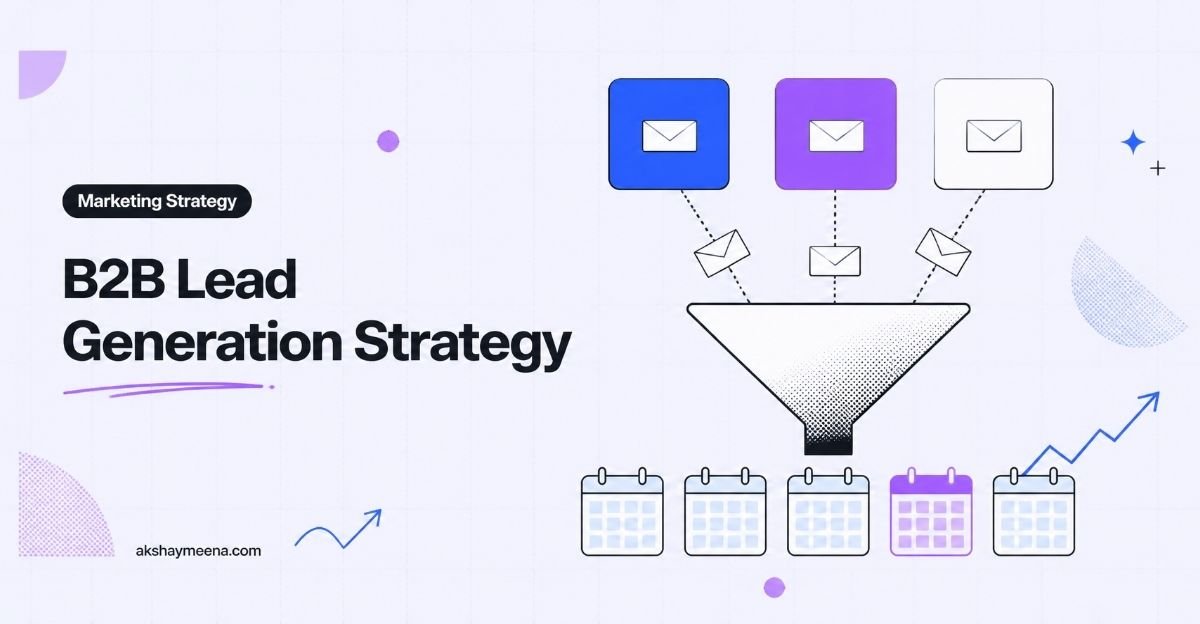
Most B2B teams don’t have a lead problem. They have a rhythm problem. They run a webinar in March, a LinkedIn push in May, a burst of cold outreach in August, and then wonder why the pipeline looks like a heart monitor.
A good lead generation strategy for B2B fixes that. It picks a few channels that fit how your buyers actually buy, pairs each one with an offer worth raising a hand for, and then runs the whole thing on a weekly cadence your team can keep up without burning out.
In this guide I’ll walk you through the exact structure I use when I plan lead generation with B2B brands: the channels, the offers, the scoring, and the weekly operating rhythm that keeps it all moving. You’ll also get a simple template you can copy.
TL;DR
- A B2B lead generation strategy defines your buyer, channels, offers and follow up process in one plan.
- Pick three channels you can run consistently, usually a mix of inbound and outbound.
- Match each offer to buyer readiness and score leads on both fit and engagement.
- Run it on a weekly operating rhythm with a Friday pipeline review shared by marketing and sales.
What is a lead generation strategy for B2B?
A lead generation strategy for B2B is a written plan that defines who you want to attract, which channels you’ll use to reach them, what offer will turn their interest into contact details, and how marketing and sales will qualify and follow up. It turns random campaigns into a repeatable system that fills the pipeline every week.
I like to think of it as four decisions stacked on top of each other. Who is the buyer? Where do they spend attention? What will they trade their details for? And what happens in the 48 hours after they do?
If you can’t answer all four in a sentence each, you don’t have a strategy yet. You have a list of tactics.
Why B2B lead generation is different from B2C
B2B purchases are slower, bigger and made by groups. Gartner’s research on the B2B buying journey found that a typical buying group for a complex solution involves six to 10 decision makers, and that buyers spend only about 17% of their buying time meeting potential suppliers.
That second number changes everything. It means most of the decision happens when you’re not in the room. Your content, your reputation and your offers have to do the selling long before a sales call.
Inbound vs outbound: which B2B lead generation approach should you use?
Most B2B brands need both. Inbound builds demand that compounds over months, while outbound creates conversations this week. The right mix depends on your deal size, your sales cycle and how many accounts actually fit your ideal customer profile.
Here’s how I compare the two when I’m planning with a team:
| Factor | Inbound | Outbound |
|---|---|---|
| How it works | Buyers find you through search, content, LinkedIn and referrals | You reach out first to accounts that fit your profile |
| Speed to first leads | Slow at first, often a few months | Fast, often within days |
| Cost over time | Falls as content and reputation compound | Stays roughly flat, since effort scales with volume |
| Lead intent | Usually higher, because they came to you | Mixed, depends on targeting and timing |
| Best for | Broad markets and education-heavy products | Small, well-defined account lists and large deals |
| Main risk | Patience runs out before results show | Generic messages that damage your brand |
My honest opinion? Small, focused B2B teams usually overinvest in one side. Founders who love writing go all in on content and starve the pipeline for six months. Sales-led teams blast outbound and never build the trust that makes outbound land. Start with a split you can sustain, then shift budget toward whatever produces qualified meetings, not just leads.
Which channels work best for B2B lead generation?
The best channels are the ones where your specific buyers already spend attention and where you can show up consistently. For most B2B brands, that short list is search and content, LinkedIn, targeted outbound, and partnerships.
Search and content
Search captures people who already have the problem and are looking for answers. It’s slow to start, but it keeps working long after you publish. The trick is to write for buyers at every stage, not just top of funnel traffic. I break this down in my guide to the content marketing funnel from TOFU to BOFU.
Write for people first. Google’s guidance on helpful, people-first content asks creators to make content mainly for people, not mainly to attract search engine visits. That’s good news for B2B experts, because real experience is hard to fake.
LinkedIn is where B2B decision makers read, argue and quietly shortlist vendors. The founder or subject expert’s profile usually outperforms the company page, because people trust people. If you’re starting from zero, a clear positioning line, a consistent posting rhythm and thoughtful comments on your buyers’ posts will do more than any paid boost.
Targeted outbound
Outbound works when it’s narrow and personal. A short list of accounts that clearly fit, a reason to reach out right now and a message about their problem, not your product. Cold email and LinkedIn messages both work here. What doesn’t work is sending the same template to 5,000 people and calling it a campaign.
Partnerships and referrals
Partners who already serve your buyers can introduce you with trust built in. Think agencies, software you integrate with, or consultants in a neighbouring field. Referrals from happy clients sit in the same bucket. They’re rarely high volume, but they close faster than almost anything else.
What offers turn B2B visitors into leads?
An offer is the reason someone gives you their details. In B2B, the best offers solve a small, specific problem right now and point naturally to the bigger problem you solve. Generic newsletters and “contact us” buttons rarely move a busy decision maker.
I match offers to buyer readiness. Early visitors want to learn. Middle stage buyers want to compare. Late stage buyers want proof and a clear next step.
| Buyer stage | What they want | Offer ideas |
|---|---|---|
| Early (learning) | Understand the problem | Checklist, short guide, template, newsletter with real insight |
| Middle (comparing) | Evaluate approaches and vendors | Comparison guide, webinar, calculator, case study |
| Late (deciding) | Confidence and a clear next step | Free audit, consultation, demo, pilot project |
How to build a lead magnet that people actually use
- Pick one painful task. Choose something your buyer does every month and finds tedious, like building a report or scoring accounts.
- Make it usable in 10 minutes. A template or checklist beats a 40 page ebook almost every time.
- Show your thinking. Add short notes that explain why each step matters. That’s where your expertise shows.
- Connect it to your service. The last page should explain what the bigger version of this problem looks like and how you help.
- Keep the form short. Ask only for what sales genuinely needs at this stage. You can learn more later.
How do you qualify and score B2B leads?
Lead scoring ranks leads by how well they fit your ideal customer and how strongly they’ve engaged. Fit tells you whether they could buy. Engagement tells you whether they might buy soon. Sales should only get leads that score well on both.
Keep the first version simple. I’ve seen teams build scoring models with dozens of rules that nobody trusts. A short model that sales agrees with is far more useful.
A simple lead scoring model
| Signal type | Example signal | Points |
|---|---|---|
| Fit | Company size and industry match your ideal customer | +20 |
| Fit | Job title is a decision maker or strong influencer | +15 |
| Engagement | Visited pricing or services page | +15 |
| Engagement | Downloaded a middle stage offer or attended a webinar | +10 |
| Engagement | Opened or clicked recent emails | +5 |
| Negative | Student, competitor or personal email domain | -20 |
Once the score is live, agree on the handoff. What counts as a marketing qualified lead? What makes it sales qualified? And how fast does sales follow up? Write these down. Most lead leakage I see comes from fuzzy handoffs, not bad leads.
This is also where automation earns its keep. A CRM workflow can score leads, alert the right rep and send a polite follow up when nobody replies. If WhatsApp is a big channel in your market, I’ve covered how to set up WhatsApp automation for lead capture and follow ups.
The weekly operating rhythm for B2B lead generation
A weekly rhythm is what turns a lead generation strategy into results. It gives every channel a fixed slot, keeps marketing and sales talking, and makes sure you review numbers before problems grow. Without it, even a great plan drifts within a month.
Here’s the rhythm I recommend for a small B2B team. Adjust the days, but keep the shape.
| Day | Focus | What happens |
|---|---|---|
| Monday | Plan | Review last week’s numbers, pick this week’s content topic and outbound account list |
| Tuesday | Create | Write and publish one piece of content, schedule LinkedIn posts |
| Wednesday | Reach out | Personal outbound to the week’s accounts, comment on buyers’ LinkedIn posts |
| Thursday | Nurture | Follow up on new leads, update scoring, send offers to engaged contacts |
| Friday | Review | Marketing and sales pipeline review: what converted, what stalled, what to change |
Lead generation strategy example: a mid-size B2B service firm
Let me show you how this comes together with a simple, hypothetical example. Take a B2B IT services firm that sells to operations heads at mid-size manufacturers. Deals are large, the sales cycle is a few months and the total list of good-fit accounts is a few hundred companies.
- Channels: LinkedIn from the founder’s profile, search content on operations problems, and narrow outbound to a named account list.
- Offers: a downtime cost calculator for early visitors, a vendor comparison checklist for mid stage buyers, and a free 30 minute process review for ready buyers.
- Scoring: fit is based on industry, company size and role. Engagement is based on calculator use, pricing page visits and webinar attendance.
- Rhythm: two LinkedIn posts and one article each week, 20 personal outbound messages, and a Friday pipeline review with sales.
Lead generation strategy template you can copy
Use this template to write your own plan on one page. If a section takes more than a few lines, you’re probably overcomplicating it. For the bigger picture of positioning and growth planning, pair it with my B2B marketing strategy framework.
- Ideal customer: industry, company size, role of the buyer and the trigger that makes them look for help.
- Core problem: the one problem you solve better than anyone else, in your buyer’s words.
- Three channels: where you’ll show up, and how often, for the next 90 days.
- Offers by stage: one early, one middle and one late stage offer.
- Scoring and handoff: fit criteria, engagement signals, and the definition of a sales ready lead.
- Weekly rhythm: who does what on which day, and when you review numbers.
- Metrics: leads, qualified leads, meetings booked, conversion rate by stage and pipeline value.
Content plays a big role in most of these sections. If you want a deeper plan for that piece, read my guide on building B2B content that generates leads.
Common B2B lead generation mistakes to avoid
The most common mistake is chasing volume over fit. A thousand leads that will never buy cost more than they’re worth, because your sales team spends real hours on them.
- Too many channels at once. Three channels done well beat seven done badly.
- Gating everything. Let people read your best thinking freely and save forms for offers with real practical value.
- Slow follow up. Interest fades fast. Agree on a response time and stick to it.
- No feedback loop. If sales never tells marketing which leads closed, your scoring never improves.
- Measuring leads, not pipeline. Track qualified meetings and revenue, not just form fills.
I share more lessons like these from my own client work as I learn them, so feel free to connect with me on LinkedIn and tell me what’s working for you.
Key takeaways
- A lead generation strategy for B2B answers four questions: who, where, what offer and what happens next.
- Most B2B brands need a mix of inbound and outbound, weighted by deal size and sales cycle.
- Match offers to buyer readiness: learn early, compare in the middle, prove at the end.
- Score leads on fit and engagement, and write down the handoff rules with sales.
- A weekly operating rhythm beats occasional big campaigns because it compounds.
Frequently Asked Questions
What is the best lead generation strategy for B2B companies?
There is no single best strategy for every company. The best one fits how your buyers research and buy. For most B2B brands, that means a mix of search content, LinkedIn from a trusted expert, and narrow, personal outbound, supported by offers matched to each buying stage and a weekly review with sales.
How long does B2B lead generation take to show results?
Outbound and paid campaigns can start conversations within days if your targeting is sharp. Content and SEO usually take a few months before they bring steady inbound leads, but they keep working after that. I plan for 90 days before judging a channel, and I track early signals like replies and engaged visitors along the way.
What is the difference between inbound and outbound lead generation?
Inbound lead generation attracts buyers who find you through content, search, social media or referrals. Outbound lead generation means you contact potential buyers first, usually through cold email, LinkedIn messages or calls. Inbound builds compounding trust, while outbound creates faster conversations with specific accounts. Most B2B teams get the best results by combining both.
How do I generate B2B leads without paid ads?
Focus on channels that run on effort rather than budget. Publish helpful content that answers your buyers’ real questions, post consistently on LinkedIn, send personal messages to a short list of well-fit accounts, ask happy clients for referrals and partner with businesses that already serve your audience. These compound over time.
What is a good lead magnet for B2B?
A good B2B lead magnet solves one specific, recurring problem and can be used quickly. Templates, checklists, calculators and short comparison guides tend to work well. It should show your expertise and lead naturally to the bigger problem you solve. Keep the sign-up form short so busy decision makers don’t give up.
How do I measure B2B lead generation success?
Measure beyond the number of leads. Track qualified leads, meetings booked, conversion rate between each stage, pipeline value and revenue that started from each channel. Review these every week with sales. A channel with fewer leads but more qualified meetings is usually worth more than one that produces lots of unqualified form fills.
Ready to build a pipeline that runs every week?
You don’t need a bigger team to make a lead generation strategy for B2B work. You need a clear buyer, a few channels you can sustain, offers people want and a weekly rhythm that keeps it all moving. Start small, review every Friday and improve one thing at a time.
If you’d like a second pair of eyes on your plan, or help setting up the content and automation behind it, get in touch with me here. I’d be happy to look at where your pipeline is leaking and what to fix first.

